Send your deck to the bot. Get back a verdict, a 0–100 score and slide-by-slide comments showing exactly where investor trust breaks, and how to fix it.
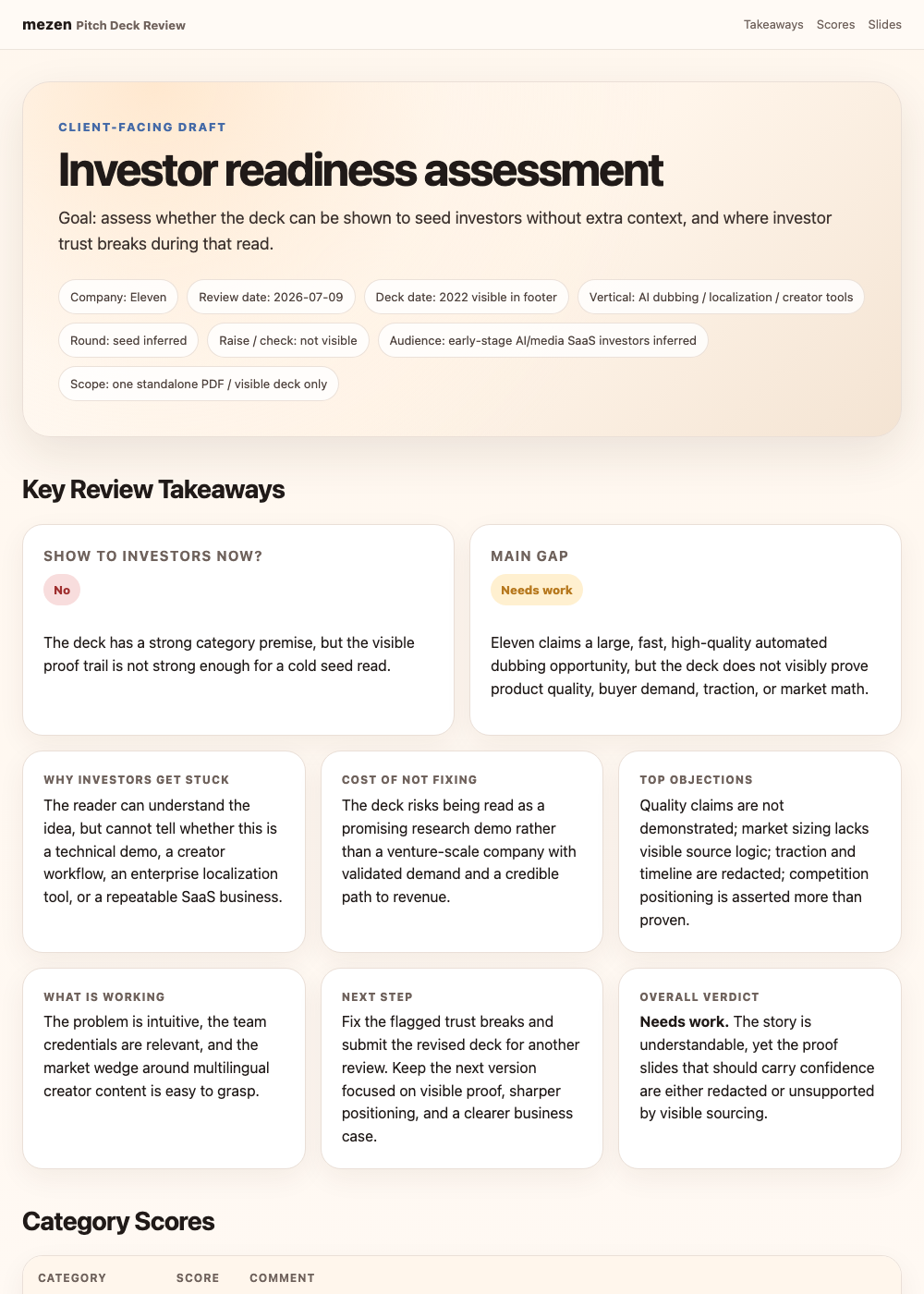
Review my deck ($5)This is the deck ElevenLabs used to raise $2M before becoming a multi-billion-dollar company (the public copy has traction and timeline redacted). Our review still found exactly where a cold investor read breaks. Yours gets the same treatment.
Zoom into one slide. The market slide, and what the review pinned to it:
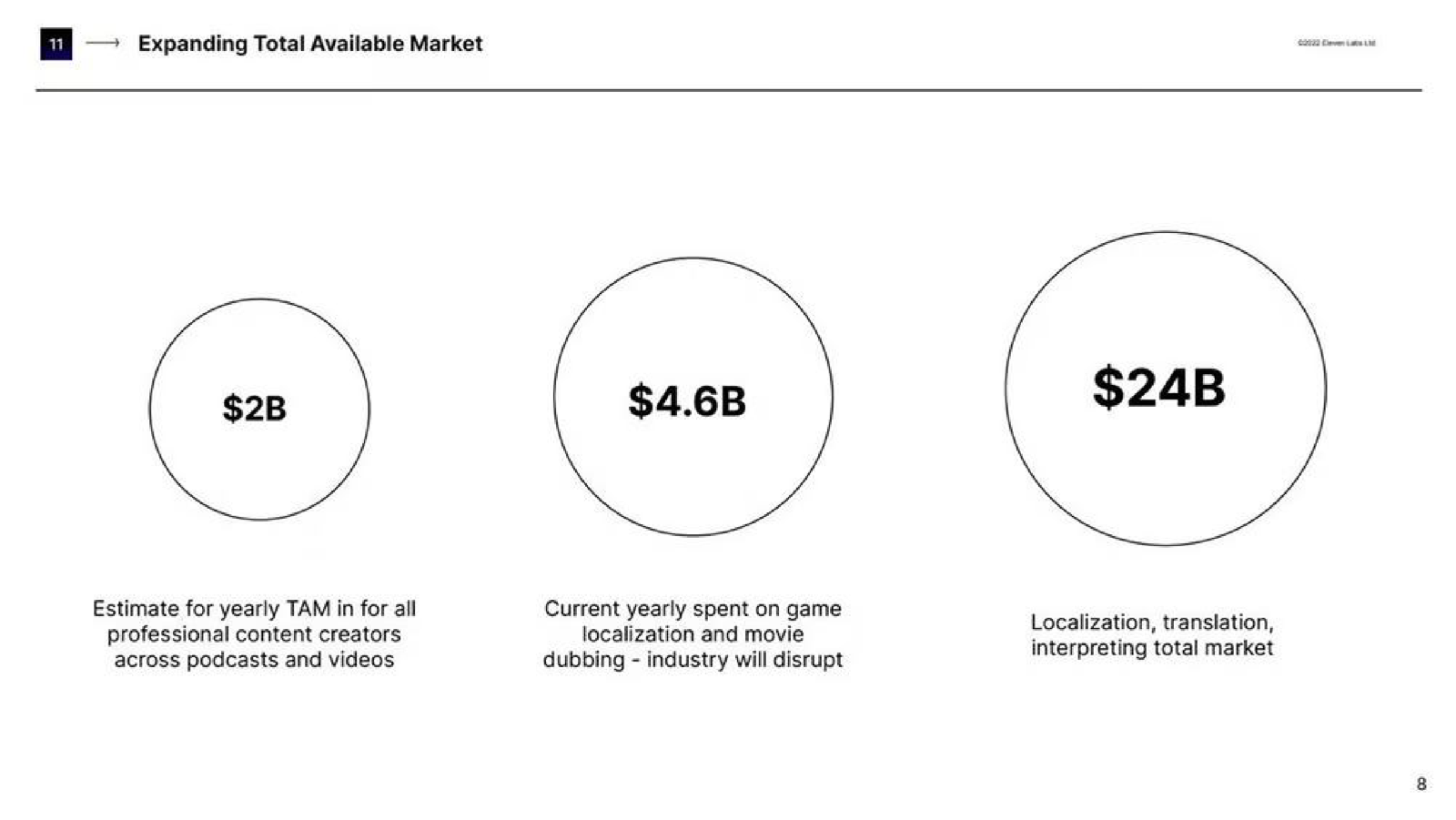
Methodology is not visible: the reader cannot evaluate how these numbers were calculated or whether they map to the obtainable wedge.
Professional creators, game localization, movie dubbing, translation and interpreting are not yet tied into one credible beachhead.
The deck can start a conversation, but it needs stronger visible proof before it can carry a cold investor read.
The whole exchange lives in one Telegram chat. You are never waiting in the dark.
Telegram Stars, inside the chat. No signup, no email, no card form.
PDF, up to 15 slides. Longer deck? The bot asks which pages to review.
Every slide is read, scored against the rubric, and the report passes an automated quality gate.
One message: verdict, 0–100 score, category scores, slide-by-slide comments. Like the sample above.
Six of the 42 comments from the ElevenLabs sample, word for word.
Investor context is missing: round, ask, audience, and current company stage are not visible on the opening slide.
The ~$100/min and >2 weeks numbers are load-bearing, but no visible citation or methodology supports them.
“Human quality” is the core promise, but the deck does not yet prove it with examples or validation.
After market sizing, the reader needs proof; the redacted block interrupts the argument at the worst point.
Google, Palantir, Cambridge/Oxford/Imperial, NeurIPS and open-source signals are relevant to the technical challenge.
The close does not restate round, raise amount, use of funds, or desired next conversation.
Not one prompt. A pipeline that reads your deck the way an investor does, then checks its own work.
The report is written to be actionable by the tool you build your deck with. Paste it into ChatGPT, Claude, Gamma or Pitch together with your deck, and let it apply the fixes slide by slide.
Copy that prompt as-is. The review's structure (verdict, categories, per-slide comments) is what makes it work as AI input.
The model is table stakes. The product is the rubric: 50 investor deck-teardown sessions transcribed, 180+ timestamped rulings coded into scoring rules, checklists from YC and 500 Startups, 13,000+ lines of review methodology, and an automated quality gate on every report.
A chatbot gives you opinions and a 78. This gives you the exact slide where investor trust breaks, scored on a harsh curve: the famous deck above got a 62.
It’s the same class of review, without the human calendar attached.
Days of turnaround. Quality depends on who picks up your deck.
Mostly a score and generic advice. Samples rarely shown, for a reason.
Full report in ~10 minutes. Useless? Full refund, no questions asked.
No. It is a multi-step pipeline: slide rendering and OCR, a slide map, a 35-point rubric across 6 lenses calibrated on transcribed investor teardowns, claim cross-checks, and an automated quality gate that blocks weak reports. About 1.5M tokens of work per review.
Yes. Your deck is never shared, published, or used as a sample. Public samples like the ElevenLabs review are made only from decks that are already public.
An HTML report in Telegram: verdict (ready / nearly ready / needs work / not ready), 0–100 score, 9 category scores, and slide-by-slide comments. Read the sample above; yours has the same depth.
PDF, up to 15 slides reviewed per run. For longer decks the bot asks which page range to focus on.
Full refund, no questions. So far the refund count is zero.
Find it before the investor does. Ten minutes, five dollars.
Review my deck ($5)